Roof terrace design is, we think here at Aralia, one of the most technically challenging forms of garden design, for a whole host of reasons that don’t appear immediately apparent to the innocent and uninformed. All of the usual design principles come into play with a roof terrace, but added to which there is a real melting pot of potentials for disaster! We do so hope that the technical tips below will help to inform, the uninformed, and to at least provoke the kind of question’s discussion and research that will help you avoid any potential pitfalls.
Technical Tips
1) Structure & Weight: If you’re not using a Garden Designer then get a structural surveyor involved to calculate whether your current roof is strong enough to take the weight of what you plan to do. If it’s not strong enough, you may need to consider additional strengthening to the roof or modify your ambitions for the terrace.
2) Safety: any roof terrace requires a minimum of 1100mm balustrade/wall to meet legal requirements. Do consider the positioning of any permanent planters close to the boundaries, since these will negate planning regulations (if a planter is 400m high and is next to a 1100mm balustrade then you only have a minimum of 700mm which does not meet regulations).
3) Drainage: where does the water currently go to, where do you plan for it to go to using your new plans? Is the current drainage system robust enough to cope with any additional water run off?
4) Material Selection: choose materials that will cope with the site and aspect. The higher from the ground the more open to the element’s, and the more UV plays a role in degradation. Choose quality materials that are durable and robust and are fit for purpose.
5) Feature Selection: choose items that can be securely fastened (if need be) to the roof terrace and that are suitable for a potentially windy aspect. Water features need to be carefully selected to avoid water being blown all over and any screening panels need to allow the wind to permeate thru, so as not to cause a wind tunnel affect.
6) Plant Selection; lots of plants do not cope well with the stressful environment of a roof terrace, so choose plants that can cope with the wind and it’s drying effect – coastal plants are often a good choice.
7) Build & Access: access can often be challenging, and cranes are often the only way to get larger plants, trees and features up to the Roof Terrace level. Constructing a roof terrace is not for the faint hearted and our strong advice would be to only use a construction company who is experienced in this sector. And, unless the project is very simple we would always advise using an accredited Garden Designer, even if on a consultation basis only. It is money very wisely spent and you will not regret it.
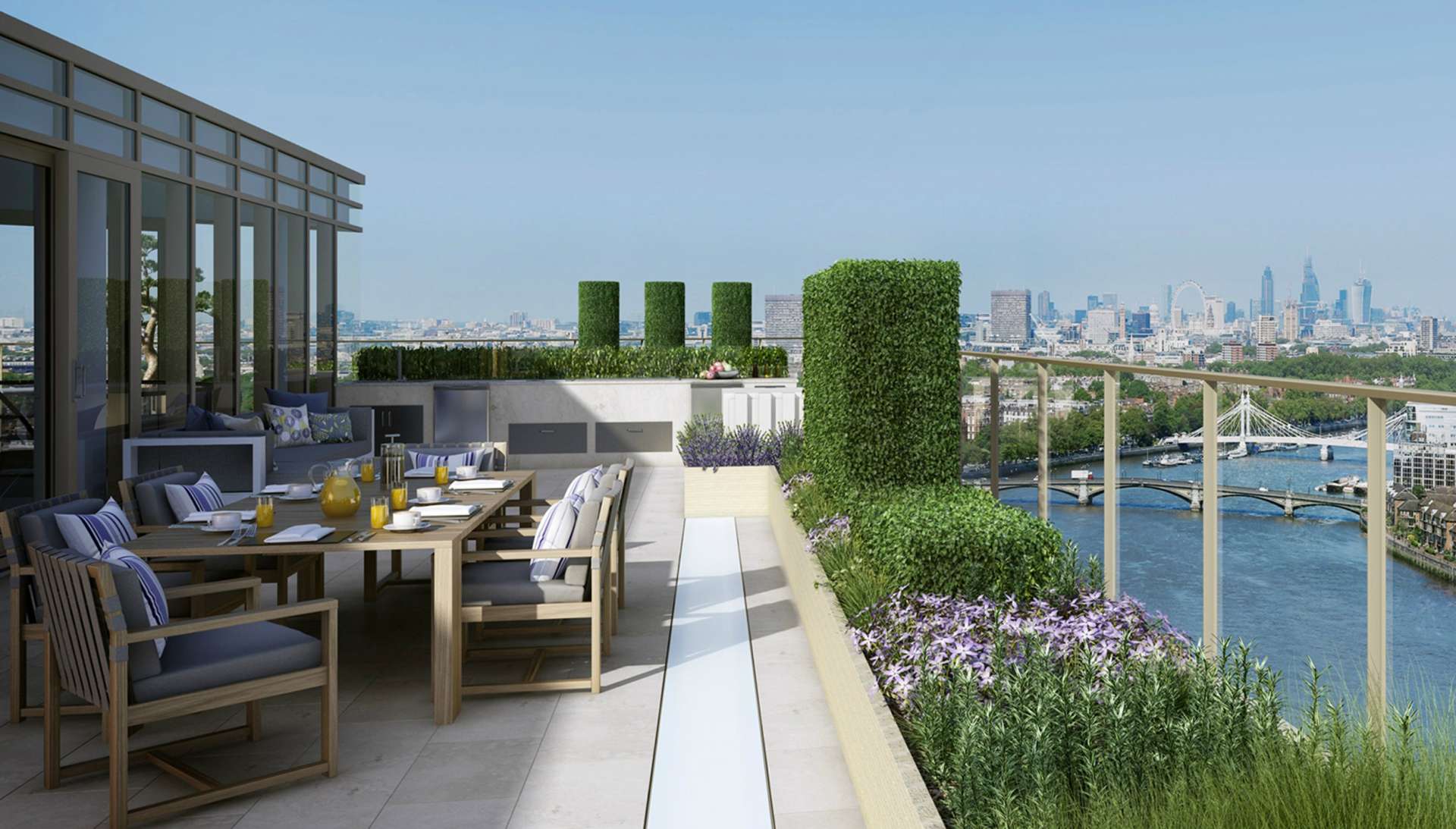
On a more positive note roof terraces offer a fantastic opportunity to extend the interior out into the exterior space. We are all demanding far more now from our garden spaces, and roof terraces are becoming more and more sophisticated and are perfect for outdoor entertaining. We have recently designing a series of eleven penthouse roof terraces at Chelsea Creek, for a leading London developer and we have included features such as outdoor kitchens, outdoor fireplaces, sculpture and art, water features, hot tubs, green walls, outdoor lighting and of course plants and planters. The roof terraces combine a series of outdoor lounges and outdoor dining areas, with amazing views over London.
The design challenge with roof terraces is often to not only open up the great views, but also to screen off the poor views and to provide privacy combined with a feeling of intimacy into the space. The Knightsbridge roof terrace project designed by Aralia, and which was awarded gold and best roof terrace at th New Homes & Gardens Awards 2014, was a massively challenging space. When Aralia first visited it felt like a corridor, which was not only severely overlooked by the neighbouring mews house opposite, but also had that corridor feeling with towering four storey buildings on either side. We decided to create a series of 3 small garden spaces – dinning, lounge and mini snug – and introduced overhead metal arches to contain the space, and to help it feel less like a corridor. We threw in of course a few wow features, such as a full length water feature that you step over; a fire table to provide warmth and ambience; specimen trees in planters to frame the entrance and the space in general; and a mix of bespoke furniture. The final result we feel is a roof terrace that offers flexible outdoor living, with loads of lovely places to sit and relax, all in a space that now feels intimate and welcoming and provides, a good level of privacy.
Images from Aralia’s Roof Terrace Projects, Knightsbridge Roof Terrace and Chelsea Creek