The new perennial movement has, in the last ten years or so, once again captivated the horticultural and design industries sparking waves of planting designs which are rather herbaceous-heavy. They manifest in various forms; masses, swathes, prairies, matrix’s, all evoking or attempting to evoke naturalistic environments is some manner, the end result being particularly appealing to vast majority of the general public and designers alike. However many images of these types of gardens, I would hazard a guess, are taken during the late summer or autumn when the plants are at typically perceived as being at their peak.
Which begs the all too familiar question ‘What will it look like during winter?’ In my personal opinion, these types of plantings look just as enchanting, if not even more so during the dormant months when the colour fades and is replaced by muted tones of skeletons, silhouettes and seed heads, coated in frost and snow. These types of garden take on a much more eerie atmosphere at this time of year, creating a sombre feeling, almost evocative of being in a deserted city or forgotten landscape. Schemes evolve into a more chaotic, haphazard nature once the autumnal climate has taken its toll. I think this heightens the sense of adventure; something which seems to be lacking in contemporary garden design, something which is so important to giving narrative to a space. Whilst evergreen plants sit idle, mostly unchanged from what they looked like a few months ago, herbaceous plants evolve throughout the year, creating an dynamic landscape which never stands still.
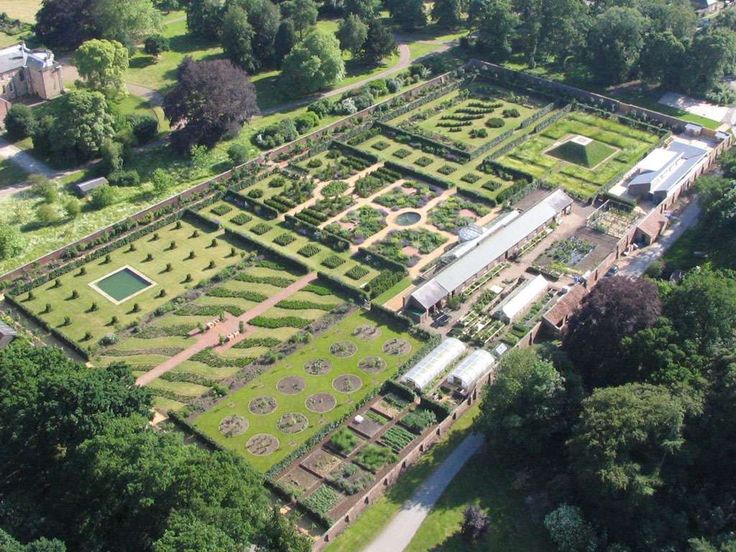
However, upon further study of the exemplary gardens and landscapes of this style of planting, it is apparent that they all have one thing in common; scale. Not necessarily large sites, but vast areas of vegetation in themselves – a far cry from the size of beds and borders achievable in most private gardens these days. These spaces have been cleverly manipulated by the creator to host such types of planting, so that despite the lack of colour and form from any winter flowering shrubs, there is still much interest held within the sculptural forms of the geometrically laid out partitions, features and boundaries, and the perennial seas held within. A good example of this would be Scampston Hall; easily read when viewed from an aerial perspective.
This leaves me to question how this style of planting would be applicable and successful to residential gardens of a comparatively much smaller size. Given that it is such a popular aesthetic desirable to many, it often gets brought up in the same design brief that includes a request for ‘year round interest’ (as do pretty much all). Despite how far one understands or appreciates the thought, concept and meaning behind the perennial garden aesthetic over the dormant months, it is sometimes difficult communicating that reasoning to clients – who for the most part may stereotype the look as ‘dead’.
Finding the balance between all of the above is the key to delivering a scheme which fulfils all the aspirations and expectations of having a garden successfully designed and planted. Plant selection in a small gardens or restricted planting areas is imperative to establishing a successful scheme; plants must hold a symbiotic relationship not just with their adjacent neighbour, but across the entire scheme. Perhaps the biggest mistake of smaller spaces taking on the perennial challenge is the breadth of species; the diversity of the plant palette should be reduced accordingly with the size of the space in order to be coherent.
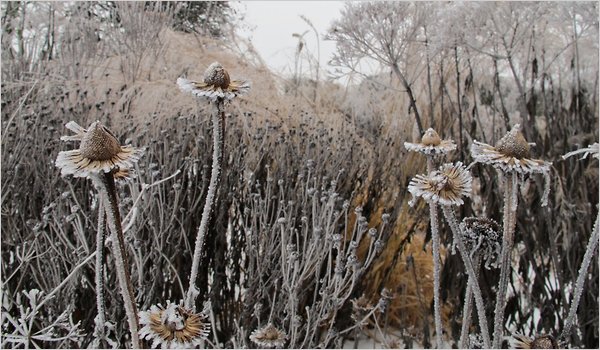
A one-of-each tactic soon results in plants becoming ‘lost’ – either overgrown by a neighbouring competitor or sat isolated, looking rather odd and out of place. Perennials within a mixed planting scheme should be grouped in threes, fives or sevens depending on the scale of the site, and the groups should relate to the plants around them – be it other groups or feature shrubs or trees. This may be a relation based on leaf type, texture or form or even a contrast. Colour, in the stereotypical sense of the word, is the most ephemeral element about herbaceous plants, deeming it almost irrelevant when selecting species for a winter garden. With that being said, there is a difference in the muted tones we are left with after summer colour fades; the lighter flower heads of Deschampsia and Molinia catch winter light far better than many others which are comparatively darker. Equally, darker seed heads such as those of Sedum and Echinacea add a heightened sense of drama to the equation with bold, almost black silhouettes against lighter grasses.
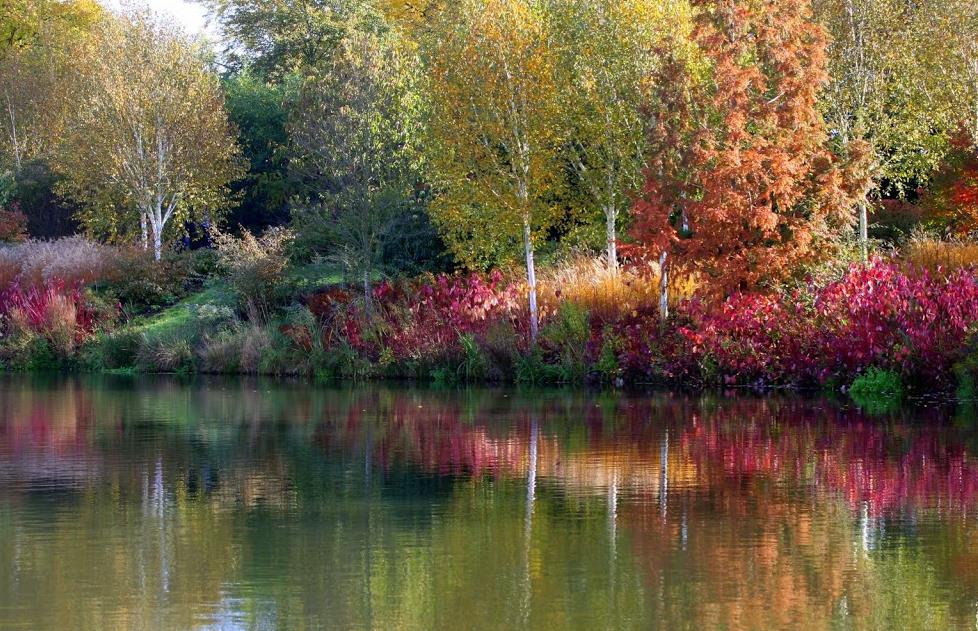
Structure is by far the most important attribute for winter perennials not just from an aesthetic perspective, but from a climatic point of view; winter conditions are of course far harsher and many summer specific plants will be too weak to withstand strong winds and rains. Pioneers of the winter climate include Calamagrostis and Miscanthus species which are often selected primarily for their winter structure and juxtaposed with shrubs of flower and stem colour to create a winter garden in the true sense of the word. One of the most successful examples of this type of landscape is the winter garden at Marks Hall which uses the adjacent lake to reflect and extend the visual scale of the scheme.
The new perennial movement is no longer an innovative practice; it’s been around as a trend for years, and naturally there are industry professionals now questioning its relevance and/or application – as they would with any dogmatic trend – which is important, because that’s what keeps our profession fresh. However, we should be concentrating this scrutiny on expanding and diversifying methods of use, not dismissing the entire principle whole heartedly. I think we could be seeing a paradigm shift in the way perennials are used in gardens very soon, but I certainly don’t think they could ever be overlooked or left behind. I hope to see perennials being used in a new and unique way, not because existing practices are becoming too common or repetitive, but because the potential is far greater than perhaps we are exploiting at this point in time. Perhaps the perennial winter garden is the answer, perhaps not. Watch this space…
Images from left to right: Scampston Hall aerial shot, Echinacea Seedheads in Winter, Marks Hall Garden in Winter